
In the light of India's increasingly 'darkening' threat environment and the convergence of strategic interests between China and Pakistan, the IAF's declining combat capabilities are a cause for concern, says Brigadier Gurmeet Kanwal (retd).

New Delhi's growing defence partnership with Tokyo could take wing with the US-2 (Utility Seaplane Mark 2), a one-of-a-kind amphibious aircraft that has Indian naval planners goggle-eyed.

'With two nuclear neighbours, how likely is it for our armed forces to battle in a contaminated environment that could include nuclear, biological or chemical attacks by the adversary?' 'Are we prepared for the threat?' Brigadier S K Chatterji (retd) explains the meaning and significance of Operation Vijay Prahar.

The defence ministry has put on hold all existing and future deals with Rolls Royce pending a CBI probe ordered into allegations of bribery and engaging middlemen in contracts worth Rs 10,000 crore for supply of aircraft engines to state-owned HAL.

'Clearly, from the Indian viewpoint, the US retrenchment from Asia cannot be happening as good news.' 'The abandonment of the US' pivot to Asia exposes the US-Indian partnership to be a mere transactional relationship,' says Ambassador M K Bhadrakumar

'This is the first time the US has formally recognised the threat India faces from terrorist organisations based in Pakistan.'

'The current crisis is one of incomes, driven by poor job growth, agrarian distress and poor investment sentiment,' notes Harsh Pati Singhania, director, JK Organisation.

India is failing to take advantage of its important ally, Japan as much as it should, notes Mihir S Sharma.
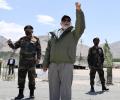
'Breaking down silos and ensuring a more integrated governance process is just as important to performance.' 'It has been a major priority in the last six years, especially in national security,' External Affairs Minister Dr Subrahmanyam Jaishankar points out when delivering the Sardar Patel Memorial Lecture-2020: India and the Post-Covid World.
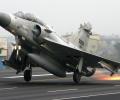
A realistic assessment will tell us that not much has changed between India and Pakistan; the relationship remains as fraught as before with little prospect of reconciliation, notes Ajai Shukla.
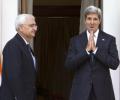
The United States on Monday assured India that its concerns over Taliban insurgents gaining legitimacy without severing their terror links will neither be "overlooked or undermined" during the talks with the Islamic fundamentalist group.

Although Suu Kyi has won an overwhelming victory, it is not going to be easy to translate this victory into political gains.

'Trump forgets that Kim is not one who likes to be treated publicly as a pauper; he wants to come to the table as an equal, and from a position of perceived strength, not as a suppliant,' says Dr Rajaram Panda.

Given the concerns around trade wars that threaten to jeopardise global capital flows as well, attracting foreign capital needs to be a policy priority, says Neelkanth Mishra.

India has made a good beginning in the area of satellite navigation but still there is a long way to go.

'Notwithstanding the realisation among the Indian leadership to build up its navy for the force's expanding role, the Indian Navy was allocated only 15% of the interim defence budget presented in Parliament in February 2019.' 'The outlay for the navy's capital acquisition is not even adequate to meet its committed liabilities,' points out Brigadier S K Chatterji (retd).

New Delhi must indicate to Afghan President Ashraf Ghani that it has a long-term strategy for his country. It should point out that Pakistan's present Afgan policy will destabilise Afghanistan and help Islamic State, says Gautam Sen.

'Progress demands regular senior-level attention from American leaders.' 'A leaders' summit is great, but we need sustained engagement to continue to forge new agreements and find new areas of cooperation.'

'We have a common way of looking at the world, a common way of thinking, and a common set of values that predispose us to be partners. And our interests overlap greatly,' Dr Ashton B Carter, America's next defence secretary, told Aziz Haniffa/Rediff.com in an exclusive interview.

'Even if the national security framework is to be threat-based, then the division of security threats between Pakistan and China is absurd. The two threats are one.'
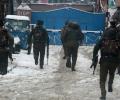
'We need to be in a perpetual state of aggression, and able to swiftly change the goal posts to keep Pakistan in a state of imbalance,' argues Sanjeev Nayyar.

'As the first leaders of their respective countries born after Indian Independence and the Chinese Liberation, Modi and Xi would be expected to have the ability to overcome the traditional mindsets and the hierarchical nature of their official/bureaucratic establishments,' say Alka Acharya and Jabin T Jacob.

'The world may be desirous of peace, but not Kim Jong-un.' 'Should we then accept the old adage that to maintain peace, we should be prepared for war?' asks Rajaram Panda.

Sanjeev Nayyar suggests 16 measures by which we can tackle our unrelenting and untrustworthy neighbour.

'A conventional war is not in fashion today and not seen as being able to deliver the objective.' 'Perhaps surgical strikes that are deeper, this time not on Pakistan's terrorist facilities, but on Pakistan army facilities.' 'The nation has to be prepared for losses.' 'War is not something that can be pussyfooted around.' 'If we go for limited number of posts in Kashmir, these are very difficult posts to capture and very difficult operations.' 'Be prepared for 200 to 300 killed.'

'India was in no position to wage another war in 1965, having suffered a morale-shattering defeat in 1962. The three services were in the middle of a modernisation and expansion phase and therefore not fully trained or battle-ready.'

It is time to throw an outer ring around India's national security by proactively engaging in areas immediately outside our neighbourhood. Such a ring will not only insulate India from emerging threats, but also create new leverage in securing our own neighbourhood, says Nitin Pai.

In his last column for Rediff.com, Praful Bidwai joins issues with those lauding India's covert operation against Naga rebels based in Myanmarese territory.

'Swachh Bharat Cess imposed last year should be made broad-based.' 'Budget should be predominantly economy/ business-oriented and problem-solving rather than political consideration-based.'

20 years ago this day, May 11, 1998, India conducted its second nuclear test at Pokharan in Rajasthan. In a fascinating interview on Rediff.com, K Subrahmanyam revealed how Indian PMs reacted to nuclear ambitions.
'The response to terror is not always reciprocal terror, nor is launching a conventional response the best response.' 'The best response is to make the sponsor pay a price he cannot afford,' says former RA&W chief Vikram Sood.
Nationalism, Hindutva, and war on corruption, not growth, will define Modi's politics until 2019.

Calling the US "the anchor of global security," Obama in a televised address offered moral, political and strategic arguments for being ready to launch limited military strikes while trying to negotiate a diplomatic solution.

Trade between India and Indonesia stands at $20 billion.

2014 was a year for downturn for most economies across the globe.

Moving ahead with their new mantra -- Chalein Saath Saath: Forward Together We Go -- Prime Minister Narendra Modi and United States President Barack Obama on Tuesday vowed to deepen cooperation in every sector for the benefit of global stability and people's livelihoods over the next ten years.

Mr Rahul Gandhi himself has given seven different prices in different speeches with regard to the Rafale, that is the 2007 offer.

A glance back at some of the important ups and down Indian Inc faced in 2018.

'For so long as the rulers of Pakistan remain committed to confronting and vanquishing India, they will sustain delusions, breed terrorists, and export them.'

'It is in the interest of both sides that the visit of the US President is seen as being successful. Both sides have invested considerable political capital in it. This rapid exchange of visits and the decisions taken have to be justified, beyond the symbolism, which is no doubt important in itself. This opportunity to impart a fresh momentum to ties should not be missed,' says former foreign secretary Kanwal Sibal.
